Showing posts with label design. Show all posts

Monday, August 11, 2014

Universal Converter Box

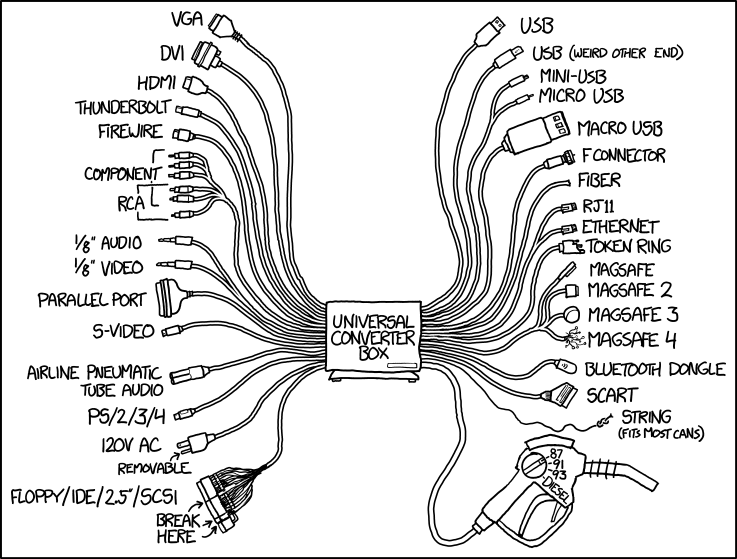
Brilliant comic on XKCD today (even more brilliant than usual, I mean).


But I knew the minute I saw it that it wouldn't be universal. With the plethora of incompatible connectors out there, most of them perpetuated by manufacturers for no good reason (I'm looking at you Apple), it simply isn't possible to cover everything.

I also had a sneaking suspicion that the artist would neglect the lack of compatibility between US and international standards. There it is down there, second from the bottom on the left, a 120V US style plug without a universal adaptor in sight!

Power outlet adaptors are one of those constant annoyances when you travel internationally. I solve the problem by taking a power strip with me, which I plug in using a single adaptor. Then I can plug all of my other devices straight into the power strip.
Sunday, October 16, 2011

The definition of awesome design

The definition of awesome design is when you don't know you desperately want something until you see it because until then you didn't even imagine such a thing existing. Like this:

Monday, November 15, 2010

Another hard drive fail

Yesterday my network attached drive failed. Unlike last time, I had all the data backed up.

It was easy enough to run down to Staples and get a new one. I couldn't get the same brand/model, and whilst all network drives do much the same things, they all do it slightly differently, so I had to spend a couple of hours getting it configured and all of the computers mapped to the right virtual drives so all my backup routines would continue to work correctly. It should have only taken 15 minutes, but the user guide was next to useless. The people who wrote it obviously have no concept of stepping the user through key concepts or common tasks.

The trickiest part was installing the client software on Marie's netbook which doesn't have a CD drive. The instructions included the following "if your computer does not have a CD drive, go to http://www.seagate.com/goflexhomesupport/" which I did, expecting to be able to download the software. No sign of it, or anything else that would help me solve the problem. So I had to copy the CD to a USB drive and install it that way.

Not a big deal really, but this is supposed to be consumer grade technology. There's no way the average consumer (i.e. someone who doesn't like to play with computers) could install this correctly.

Friday, October 15, 2010

Packaging overkill

I ordered a product online recently which arrived in this box.


Here's what was inside.


And here's the actual product.


Here's a comparison of the actual product and the mailing box. I calculate you could fit approximately 200 of these in this box.


If you are wondering what this is, I'll explain it in a forthcoming post. Hint: it fits on a helmet and I'm going to use it during the ski season.

Tuesday, July 27, 2010

Coffee as a teaching tool

Regular readers will know that I like things coffee and things geek. So I really liked this article I stumbled across today which analyses the production of coffee at Starbucks using standard information system design patterns; Starbucks Does Not Use Two-Phase Commit.

Illustrating abstract architectural concepts using real world processes is actually a very powerful teaching tool; for example, illustrating the concept of a correlation identifier by reference to Starbucks' practice of writing your name on the cup when you order.

It's a simple and effective solution, but I did have a little trouble with it when I was working regularly in the Philippines a few years ago. Filipinos are mostly accustomed to American accents; when I gave my name as Dan almost anything would end up on the cup. So I experimented for a bit until I found a name that the staff would always get right despite my Australian accent; at Starbucks Philippines I am therefore known as "Freddie".

It also reminded me of the Order Cappuccino Use Case that I used to teach how to write Use Cases; that was in South Africa where the "cappuccino with foam or cream" heresy originates.

Order Cappuccino Use Case

Basic Flow
  1. The Customer asks for a cappuccino; the Waiter prompts for Foam or Cream
  2. The Customer requests foam; the Waiter submits the order
  3. The Barista makes the cappuccino
  4. The Waiter collects the order from the Barista and delivers it to the customer
  5. The Customer drinks the cappuccino
  6. The Customer requests the bill; the Waiter delivers the bill
  7. The Customer pays; the Waiter collects the payment
  8. The Waiter returns with the change
  9. The Customer collects the change and the Use Case ends

Alternate Flow (branch at Basic Flow Step 2)

  1. A South African Customer requests Cream; the Use Case ends because that’s not a Cappuccino!

Wednesday, April 08, 2009

Abysmal user interface design (but that's not the surprise)

Here's an example of abysmal user interface design. That's not surprising; I see this crap every day. But this is from Apple! (it's part of setting up the "Genius" service in iTunes)


Is the second box for your password or does it have something to do with AOL? And what on earth does the red arrow mean?

This could easily have been fixed by putting the two radio buttons to select whether to use your Apple iTunes Store ID or your AOL ID across the top horizontally, keeping this selection visually separate from the entry of your user ID and password.

Thursday, July 17, 2008

Netflix Player gets five stars

I just got myself a Roku Netflix Player.

I've been a Netflix subscriber for a while now. After some initial teething problems I've found it an excellent service. We especially like the wide range of lesser known movies that they carry, including several quite obscure Australian movies like this one.

The only downside is because we're away a lot we often pay for a month's subscription without watching a single DVD, and there's no rollover of unused DVDs to the next month.

In recent months I've also begun watching some of the instant streaming movies and TV shows that Netflix have available. The range is still only a fraction of their overall catalog but I've been very impressed by the quality, at least on my computer monitor. Of course that's partly dependent on my Comcast cable internet connection which I am pleased to say has been steadily improving over the past four years - from typical download speeds in 2004 of 2-3 Mbps to consistent speeds of 10-15 Mbps now.

I'm also a big fan of my Roku Soundbridge so when I saw that Netflix and Roku were offering a "Netflix Player" that would let me stream Netflix video to my TV for only $99, I just couldn't resist (not to mention, being a typical techie, I love playing with new gadgets!)

I assumed that the picture quality would degrade somewhat in moving from my computer's 19 inch LCD screen to my 42 inch TV, so I didn't expect the video quality to be great. Boy was I wrong. It's certainly not High Definition (the Player supports HD including a HDMI connector but Netflix are not currently making HD content available) but it's pretty damn close to DVD quality and definitely better than my non-HD cable channels.

I also expected the occasional interruption due to network issues (either at Comcast's end or on my wireless network - the Player has a wireless 802.11g adapter built in) but I've watched several hours of content so far without a single interruption.

Like the Roku Soundbridge the user interface is excellent - simple and intuitive - and the setup was a breeze. And the unit is amazingly small. The website says it's the size of a paperback but I was still surprised. It looks positively tiny next to my other home entertainment components.

For a first release I'd have to say that it's almost perfect - five stars out of five. The only criticism I have is that you can't browse the catalog from the TV - you have to access the Netflix website on your computer and add items to your instant play queue for them to show up on the Player. But I'd be very surprised if they don't fix that in the first software update.

Here's the silly thing though, and it's silliness on the part of Comcast not Netflix. Here in Steamboat Comcast doesn't offer their On Demand service. I've been told by the local Comcast office that this is awaiting a trunk infrastructure upgrade (which will also allow us to receive the networks in HD). But Netflix and I are effectively using Comcast's infrastructure to achieve the same thing!

Thursday, June 28, 2007

Queuing theory

A short but interesting post over at Jane Galt on one of my pet hates - separate queues for multiple service points.

There ought to be a name for this kind of phenomenon - where anyone who has studied the issue knows the answer is A, but 95% of the world persists with B. Free trade is another example. Every economist in the world knows that free trade is good, but the great majority of people persist in thinking it's a bad thing.

I remember being stuck once in an immigration queue at Ben Gurion airport in Tel Aviv for 30 minutes behind a lady from Mongolia. I suspect the Israeli immigration agent didn't even know where Mongolia was, let alone get his head around a Mongolian wanting to visit Israel (perhaps she was a member of one of those long lost Jewish tribes?) And there was absolutely no way they'd let me move to another line!

Tuesday, June 19, 2007

Zuned out

Last week I used some of my credit card miles (which build up pretty quickly when you buy spend thousands of dollars a month on plane tickets and hotels) to order myself Microsoft's answer to the iPod - the Zune.

It arrived today. My first impression was that it's quite a bit bigger than the video iPod, although I'll be using it with my Bose noise cancelling headphones so that doesn't really matter.

My second impression was that it's not quite as user friendly as the iPod, but the navigation is still pretty easy.

On the upside, it's a 30Gb device so it can comfortably hold my entire music library which is great because when you're away for weeks at a time it's impossible to predict what you're going to want to listen to. The sound quality is great and the graphics are awesome.

Two things annoy me. The first and more minor issue is that you can't sych it with Windows Media Player but instead need to install a separate program which looks almost exactly like - (drum roll please) - Windows Media Player.

The second and far more annoying problem is that my Windows Media Center PC records video files in a totally incompatible format. Yes that's right, Microsoft's supposed centre for the digital home doesn't work with Microsoft's portable player.

This was going to be my main source of video to watch on this device - I had visions of catching up on all my favourite shows as I wing my way back and forth across the Pacific - so I'm more than a little annoyed. But even more than that, I just don't understand how Microsoft could be so dumb. Synergy with their desktop products, where they own the market, is their best chance of catching Apple in the MP3 player game. So what on earth were these guys thinking?

Tuesday, May 08, 2007

What's Chinese for stupid?


News flash for the web site designer who decided that http://www.priorityclub.com should bring up the Chinese version of the site because it's detected that you're in China (presumably from the IP address): because you're in China doesn't mean you can read Chinese!

Like so many examples of bad design, this is basically a case of a good idea badly executed that could easily and inexpensively be fixed (in this case the solution is as simple as adding a "click here for English" hyperlink).

By the way my colleagues here in the Beijing office tell me the answer is "ben" (pronounced more like "bn" as best I can tell).

Update: There actually is a drop down box for language selection. Of course if you don't read Chinese how would you know that this is it:

Friday, July 07, 2006

Interesting house?

On the way to Australia and NZ, we stopped last night in LA and today we visited my wife's cousin who lives in Redondo Beach (nice suburb, but makes Steamboat real estate look cheap). A few houses down the street we saw this place under construction. Yes, it is made from recycled shipping containers.


Apart from the environmental benefits it's also earthquake and fire proof. Here's what it's supposed to look like when it's finished.


Given that it still looks like a bunch of shipping containers piled on top of each other, I don't think the benefits outweigh the fact that it's really, really ugly.

Sunday, June 25, 2006

It's all about the user interface

Last year I said this about the importance of user interface design:

"Now that massive computing power can be provided in almost any device for a few hundred bucks, the real challenge is in making all of the complex and sophisticated functionality inside these boxes readily accessible to the average person."

This lesson was reinforced recently when the older of my two TiVo's died (hard disk failure).

I'd been thinking about upgrading my cable service to digital for some time, and I also wanted to have some HD content to make the most of my HD television, so rather than replace the TiVo (which TiVo offered to do for free - this is a company that knows about customer service) I decided to get the Comcast set top box with built in DVR.

With its dual tuner and HD capabilities the Motorola 6412 box provided by Comcast is in many ways far superior to the Series 2 TiVo. But in terms of usability it is pathetic when compared to the TiVo. The user interface is so bad that Marie has already asked me several times if we can't send it back and get another TiVo.

The design is particularly bad in terms of finding programs to record and reviewing your list of scheduled recordings, but there are a dozen other little things that are inferior. A good example is the way that the TiVo skips back a few seconds when you push play after you've been fast forwarding because the designers knew there would be a lag between seeing the end of the advertisements and hitting the play button. The Comcast box also doesn't have any of the Home Media features of the TiVo.

Here's the crazy thing. Motorola had two choices when they built their software. The first was to copythe TiVo user interface. The second was to develop their own lousy design which would have cost them more but this is the option they picked anyway! (1)

There is however a silver lining in this cloud. TiVo and Comcast are working on upgrading the Motorola boxes to the TiVo software later this year. I just need to distract Marie long enough.

(1) OK they couldn't just copy it. But they could have done something quite similar without running afoul of copyright laws. I have Windows Media Center on my home office computer and the DVR user interface clearly follows the same paradigms as the TiVo.

Wednesday, August 03, 2005

Appreciating good design

I just read an interesting essay by Paul Graham which in his own words tries to explain why Americans make some things well and others badly.

His basic thesis can be summed up in two points, both of which are rooted in US society and cultural values. The first is that the US is good at those endeavours like writing software and making movies which are messy processes (because figuring out what the end result will be is as much work as making it) and innovation, and therefore speed, is important.

His second point is that Americans don't value good design and craftmanship as an end in itself in the same way that the Europeans or especially the Japanese do. It's the idea that there is some independent definition of quality determined by the craftsman as opposed to the market-based definition favoured in the US that if people buy something then it must be OK.

He quotes the example of the iPod as an exception to this rule. The thing that has always distinguished Apple from its competitors is its devotion to technical excellence which is a form of good design, often it must be said, at the expense of mass market success. But the iPod bucks this trend in the sense that good design, the fact that what it does it does so much more elegantly than its competitors, is the secret to its success.

Another example is TiVo. Here is a device that was clearly built by a group of people with a devotion to design. Every other DVR I've seen does fundamentally the same things but so much less elegantly that they are boat anchors by comparison. The end result is that TiVo owners don't just like their TiVo's, we love them. Unfortunately the jury is still out on whether the market will reward TiVo's superior design with financial success, or whether the cable companies with their third-rate bundled DVRs will kill it. I hope not.

Interestingly, in both the examples discussed above, the iPod and the TiVo, much of what counts as superior design is manifested as superior user interface design. Expect this to be increasingly important in distinguishing the leading devices from the also rans. Now that massive computing power can be provided in almost any device for a few hundred bucks, the real challenge is in making all of the complex and sophisticated functionality inside these boxes readily accessible to the average person.

Monday, April 18, 2005

In flight entertainment

One of the greatest developments in civil aviation for those of us who regularly fly long haul (1) is the personal in seat video system. It doesn't give you any extra leg room but it certainly helps to pass the time.

Singapore Airlines (2) has the best system I've seen. What I really like is that it provides video on demand. You press play and the channel you've selected simply starts. If you need to talk to the flight attendant or make a bathroom visit then you just press pause and come back to your movie when you're ready. It's like Tivo (3) in the sky!

Other airlines, including the one which provides the only direct service from LA to my former home city of Brisbane (Qantas), have chosen to install a less sophisticated solution that provides a choice of a dozen or so channels which all start simulatenously and run on a loop (generally 2.5 hours) throughout the flight. A couple of things really annoy me about this.

My first complaint is that they took so long to introduce this (although not as long as their US-based transpacific competitor United who I am sure will be out of business long before they introduce any improvements to their cabin environment) supposedly because they were waiting for the technology to mature so they could install the best solution available. At least that was their excuse a few years back when I told them they were being left behind. But of course they didn't, although they may have had a good business reason for the choice they made (presumably it costs less that the state of the art Singapore Airlines system - but probably not as much as you think).

The other problem with their system is simply the result of lousy design that would have cost nothing to do right. In my view, that's inexcusable. Here's the problem. You have no way of knowing when the movies will start. So what you would like to do is select the channel you want and simply wait until the movie starts. No such luck. The system stupidly responds with "the service is currently unavailable" and drops you back to the main menu. So you're stuck repeating this every minute or so hoping that you'll eventually catch the beginning of the movie. What's even more annoying than this idiotic design (which unfortunately would now cost money to fix) is that the flight attendants absolutely refuse to make an announcement when they are starting the movies which would cost them the grand total of Nothing. Zero. Zilch. I know this because I've asked several times (very politely of course) and always received a negative response.

(1) For my American friends who link LA to NY is long haul, I'm talking travel all day to get to LA and then take a 14 hour flight to Australia. I'm talking 8 hours from Australia to Singapore and then connect with a 13 hour flight to Europe. Oh, and it's just as far from Australia to US as it is from US to Australia. So stop talking about it. I know you'd all love to visit Australia because you keep telling me! So make like Nike and 'just do it'. We'd love to have you. Paul Hogan will even "throw another shrimp on the barbie" for you.

(2) If the guys running the US legacy carriers would like to know how to operate a profitable airline that provides pleasant, efficient and well priced air services to the traveling public, I suggest they take a look at Singapore Airlines which is, without a doubt, the best airline in the world (at least of the 40 or so I've experienced. Can't speak for Air Kazakstan, but my guess is it's about as good as a US legacy carrier).

(3) It really is as good as Tivo owners claim. No, it's better.